Quick answer
Business process reengineering (BPR) is the radical redesign of a business process to achieve a step change in cost, quality, service or speed, rather than incremental improvement. Process intelligence plays its biggest role at the start and end of a reengineering program: it shows how the current process actually runs across people, desktops and systems, ranks which processes are worth reengineering by measured cost and variation, and provides the baseline that proves the redesign worked. In 2026 it also supplies the operating context that AI agents need when redesigned steps are handed to them.
Key takeaways
- Michael Hammer and James Champy defined reengineering as “the fundamental rethinking and radical redesign of business processes,” as cited by the University of Michigan.
- BPR differs from process improvement in scale: IBM notes that BPM and BPI “initiate more incremental change.”
- The famous “50 to 70 percent fail” figure was an “unscientific estimate” that Hammer later said had been “widely misrepresented.”
- Reengineering programs depend on an accurate picture of the current process; interviews alone rarely provide it.
- Process intelligence adds measured current-state data, ROI per opportunity and a baseline for proving results.
What business process reengineering is
Reengineering started with Michael Hammer’s 1990 Harvard Business Review article, “Reengineering Work: Don’t Automate, Obliterate”. Its argument was that automating existing processes preserves their flaws. In his words, reported by MIT News: “We cannot achieve breakthroughs in performance by cutting fat or automating existing processes.”
The full definition Hammer and Champy published in Reengineering the Corporation is “the fundamental rethinking and radical redesign of business processes to achieve dramatic improvements in critical contemporary measures of performance such as cost, quality, service and speed,” as quoted on this University of Michigan page. IBM describes BPR today as “the radical redesign of business processes” to achieve “dramatic improvements in performance, efficiency, and effectiveness.”
BPR, process improvement and process transformation
The three terms overlap, and the difference is mostly scale and pace. Many enterprises run all three at once, on different processes.
| Approach | Scope | Pace | Typical question |
| Business process improvement (BPI) | One process, incremental change | Continuous | How do we make this process better? |
| Business process reengineering (BPR) | One or more core processes, redesigned from first principles | A defined program | What would this process look like if we designed it today? |
| Business process transformation (BPT) | Many processes, aligned to a new strategy or operating model | Multi-year | How should the business operate end to end? |
Prosci draws the same line: business process management is “an ongoing, iterative practice that seeks continuous improvement,” while BPR “completely transforms organizational processes for dramatic improvement over a short period.” KYP.ai’s guide to business process transformation covers the broader, strategy-led version.
Why reengineering programs fall short
Reengineering has a reputation for failure, and much of it rests on one sentence. In Reengineering the Corporation, Hammer and Champy wrote that “our unscientific estimate is that as many as 50 percent to 70 percent of the organizations” that attempt it “do not achieve the dramatic results they intended,” as Entrepreneur’s review of the claim documents. A few years later Hammer and Stanton corrected the record: “There is no inherent success or failure rate for reengineering.”
The more useful lesson is about inputs. A redesign is only as good as the understanding of the process it replaces and the measurement of what it changed. Programs that base the current state on workshops, and judge success by milestones, have little evidence on either side of the change.
The steps of a reengineering program
IBM lists six steps: define goals, assess the current state, identify gaps and opportunities, develop the future state, implement changes, and evaluate and iterate. Prosci adds two people-side steps: create the team and build a business case. The structure is well established. What has changed is the evidence available at each step.
Where process intelligence fits in each BPR phase
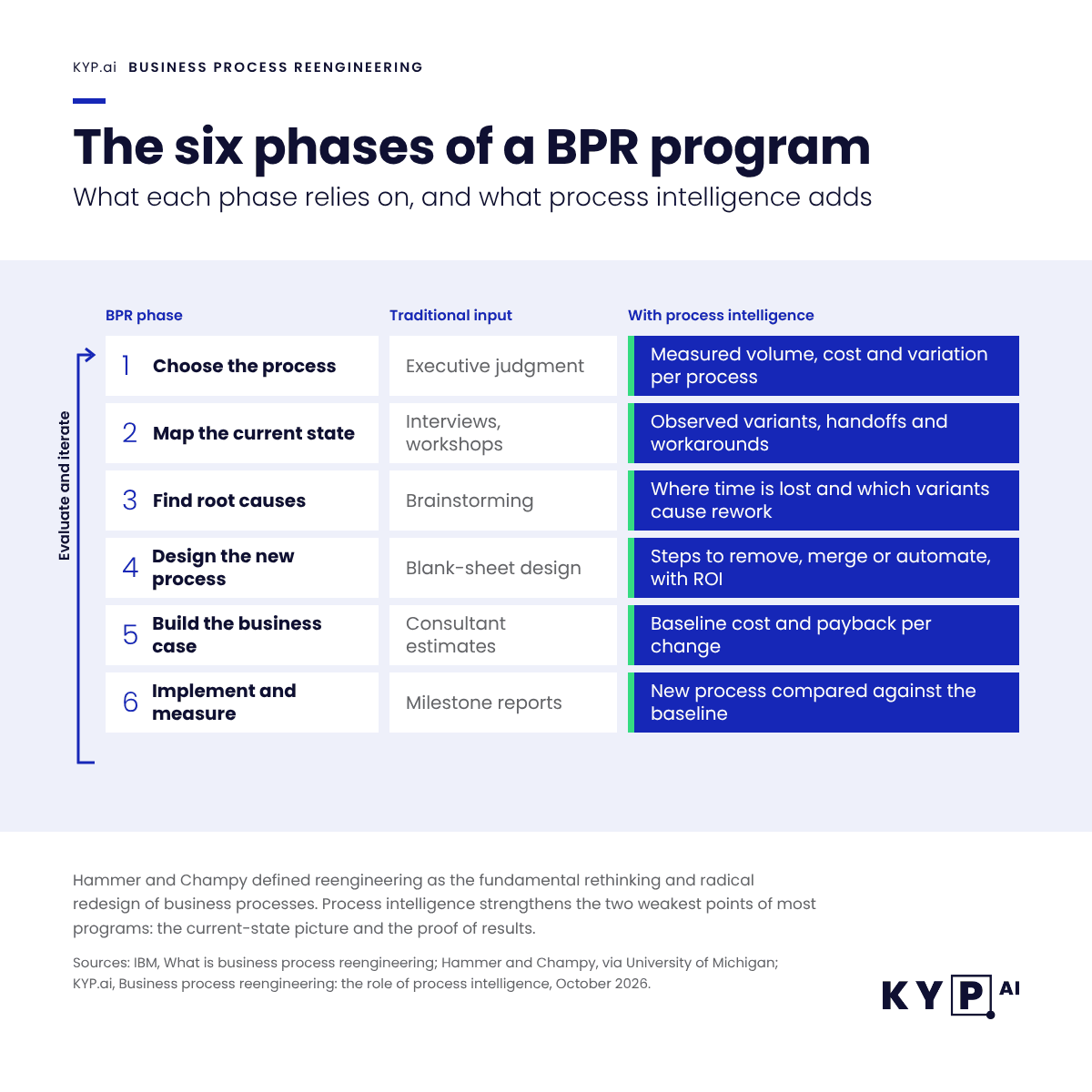
Process intelligence is most useful at the points where traditional reengineering relied on assumptions. The table maps it to the phases most BPR programs follow.
| BPR phase | Traditional input | What process intelligence adds |
| Choose the process to reengineer | Executive judgment, complaints, benchmarks | Measured volume, cycle time, cost and variation per process, so the choice rests on data |
| Understand the current state | Interviews and workshops | Observed steps, variants, handoffs and workarounds across desktops and systems |
| Find the root causes | Brainstorming and sampling | Where time is lost, which variants cause rework and which steps add no value |
| Design the new process | Blank-sheet design | Evidence on which steps can be removed, merged or automated, with ROI per opportunity |
| Build the business case | Consultant estimates | Baseline cost and a calculated payback period for each change |
| Implement and measure | Milestone reporting | Continuous comparison of the new process against the original baseline |
Reengineering with AI agents in the design
Reengineering in 2026 has a new design option that did not exist when the method was created. Some redesigned steps no longer need a person or a classic automation script; they can be handed to an AI agent.
That raises the bar for current-state evidence. An agent needs to know how the work is really done, including its exceptions, before it can take over a step. The same process data that shows what to remove also becomes the agent’s operating context. KYP.ai’s Business Transformation Engine ranks each opportunity by ROI and separates what CAN be automated from what SHOULD be, and the Agentic AI Enabler generates production-ready agent code that is platform agnostic by design: deployable on UiPath, SAP Joule, n8n, Camunda, Power Automate, ServiceNow or CrewAI.
How to run a process-intelligence-led reengineering program
- Baseline first. Use automated process discovery to capture how the candidate processes run today for long enough to get statistically relevant data. With KYP.ai that takes about three weeks after deployment.
- Rank processes by opportunity. Compare cost and variation across processes before choosing one to reengineer.
- Redesign with the data in the room. Use the observed variants and bottlenecks as the starting point for the new design.
- Decide the role of automation and agents. Separate steps to remove, steps to automate and steps that stay with people.
- Fund it with a business case Finance can verify. Attach baseline cost and payback to each change; the KYP.ai ROI calculator gives a first estimate.
- Measure against the baseline. Keep capturing after go-live and report the change in cost and cycle time, not only milestone completion.
What it looks like in practice
Qatar Airways shows how measured process data changes a redesign program. Its GBS standardized processes across 12 countries and reached self-funded ROI in two months, against an industry norm of 18-24 months, with Finance involved from day one as co-authors of the business case. John Adamek summed up the approach: “Process intelligence shows you the truth. AI helps you act on it. Finance helps you fund it.”
KYP.ai works to a four-stage deployment model: setup in minutes, live in days, statistically relevant insights in three weeks and measurable returns in 90 days. That timeline lets a reengineering team start from measured data within the first month of the program.
The bottom line
- BPR is radical redesign of core processes; it still works when the redesign rests on evidence.
- The often-quoted failure rate was an estimate its own authors later disowned.
- Process intelligence strengthens the two weakest points of most programs: the current-state picture and the proof of results.
- AI agents are now a design option in reengineering, and they need the same process data to work.
Most environments are live within days. Book a demo to see the current state of the processes you plan to reengineer.
Frequently asked questions
Business process reengineering is the radical redesign of business processes to achieve dramatic improvements in measures such as cost, quality, service and speed. Michael Hammer and James Champy defined it as “the fundamental rethinking and radical redesign of business processes,” as cited here.
A common sequence is to define goals, assess the current state, identify gaps and opportunities, develop the future state, implement changes and evaluate the results. Process intelligence supports each step with measured data on how the process actually runs.
BPR redesigns a process from first principles for a step change in performance, while business process improvement makes incremental changes to an existing process.
The figure comes from Hammer and Champy’s own “unscientific estimate” that 50 to 70 percent of organizations do not achieve the dramatic results they intended. Hammer later wrote that “there is no inherent success or failure rate for reengineering,” as documented by Entrepreneur.
Process intelligence shows how the current process actually runs, ranks processes by measured cost and variation, quantifies ROI for each redesign option and provides the baseline for measuring results. It replaces interview-based assumptions with observed data.
The data foundation is quick to build: with KYP.ai, statistically relevant insights arrive within three weeks of deployment and measurable returns within 90 days. The redesign and change management that follow depend on the scope of the processes involved.
Get your process intelligence with the ROI attached - Book a demo!
Book Demo

 Szymon Kozak


 Wojciech Zytkowiak-Wenzel





 Adam Bujak

 Felix Haeser