Quick answer
Organizational memory in AI is the stored knowledge an organization’s people and AI agents draw on to act: documents, decisions and, most often missing, a record of how work is actually done. The classic research definition describes organizational memory as “stored information from an organization’s history that can be brought to bear on present decisions.” AI raises the stakes, because an agent can only act on the context it is given. Process intelligence builds the missing layer by capturing how work runs across desktops and systems, structuring it into processes with time, cost and variants and making it queryable for people and agents.
Key takeaways
- Organizational memory has a documented layer, a decision layer and a process layer; most AI projects only feed agents the first two.
- In a Panopto survey, employees reported that “42 percent of institutional knowledge is unique to the individual.”
- Agents fail on undocumented exceptions, so process memory decides whether they work in production.
- Process intelligence captures process memory continuously from observed work, anonymized at source.
- Through MCP, AI agents can query that process memory directly at runtime.
What organizational memory means
Researchers have studied organizational memory for decades. In the definition by Walsh and Ungson, cited in an IGI Global chapter on organizational memory, it is “stored information from an organization’s history that can be brought to bear on present decisions.” Later work separates two kinds of memory: in Moorman and Miner’s study in the Academy of Management Review, “organizational procedural memory (skill knowledge) and declarative memory (fact knowledge)” shape outcomes in different ways.
That distinction matters for AI. Declarative memory, the facts and documents, is what most knowledge tools store. Procedural memory, the skill of how work gets done, mostly lives in people. When those people move on or are simply busy, the organization loses access to it.
Why organizational memory is now an AI problem
Knowledge loss was already expensive before AI. The Panopto survey estimated that US knowledge workers waste 5.3 hours every week waiting for colleagues or rebuilding expertise that already exists, and the McKinsey Global Institute found interaction workers spend nearly 20 percent of their week looking for internal information or tracking down colleagues who can help.
AI agents make the gap visible. Fortune’s coverage of the MIT NANDA study attributes most failed enterprise AI pilots to a “learning gap” for both tools and organizations, with generic tools that stall because they don’t learn from or adapt to workflows. Gartner predicts that “through 2026, organizations will abandon 60% of AI projects unsupported by AI-ready data.” An agent with no memory of how the business works starts every task from zero.
Three kinds of organizational memory
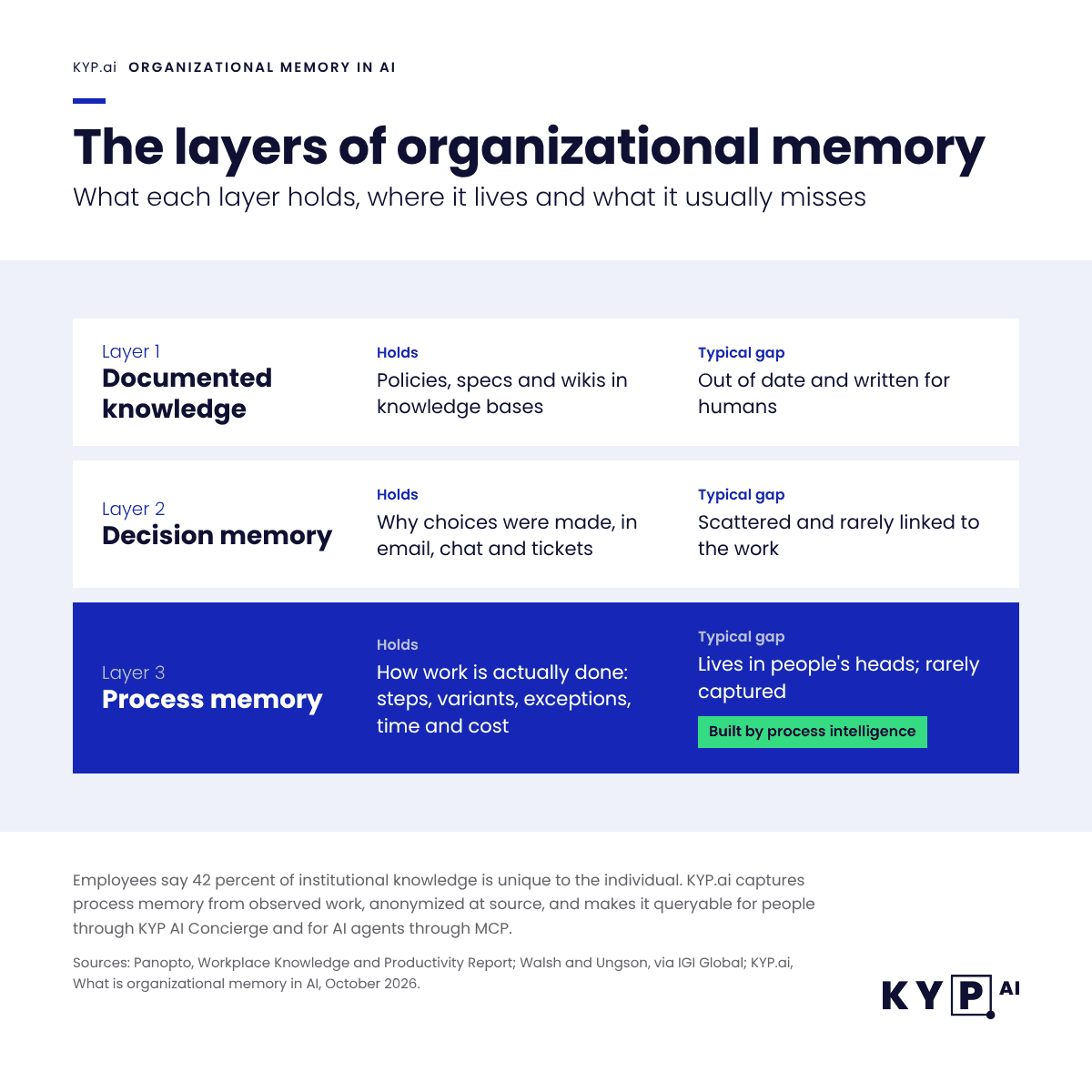
Most discussions of organizational memory focus on what people wrote down. That is only one layer. For AI, it helps to separate three kinds of memory, because each one is captured differently and each one fails differently.
| Layer | What it holds | Where it lives today | Typical gap |
| Documented knowledge | Policies, specs, wikis, contracts, meeting notes | Knowledge bases, document management, enterprise search | Out of date, incomplete, written for humans |
| Decision memory | Why choices were made, who approved them, what changed | Email, chat, tickets, meeting transcripts | Scattered, rarely linked to the work it affected |
| Process memory | How work is actually done: steps, variants, exceptions, handoffs, time and cost | Mostly in people’s heads and habits | Rarely captured at all |
The first two layers are well served by knowledge management and AI search tools. The third is where enterprise AI most often breaks. An agent can read the procurement policy and the approval thread and still fail the first time an invoice arrives without a purchase order, because nobody wrote down what experienced staff do in that case.
Why AI agents need process memory
A language model starts every task without knowledge of your business, a problem covered in more depth in the guide to context engineering for enterprise AI agents. Retrieval gives it documents. Process memory gives it the operating reality those documents describe only partly: which steps people actually take, in which applications, in what order, and how they handle exceptions. Process memory matters for three practical reasons:
- Choosing what to automate. Agents should go where the volume and the value justify them. That requires measured data on how often a process runs, how much it varies and what it costs.
- Designing the agent. The exception paths in the real process become the agent’s instructions and guardrails.
- Checking the result. A baseline of how the process ran before the agent arrived is the only way to prove the agent improved it.
How process intelligence builds organizational memory
Process intelligence captures how work is done across desktops, applications and systems, then turns that activity into structured process knowledge. KYP.ai calls the result Organizational Memory: the behavioral intelligence layer that builds up over time as the platform observes how work actually runs. Building it follows five steps.
- Capture work where it happens. KYP.ai records user activity across desktops, applications and virtual environments, anonymized at source, so the raw material is observed work.
- Structure it into processes. Activity is grouped into steps, variants, handoffs and exceptions, with time and volume attached, so the result reads as process knowledge.
- Attach business context. Steps are linked to the business objects and outcomes they serve, which is what makes the memory usable by people who did not do the work.
- Keep it current. Capture is continuous, so the memory updates as systems and workarounds change, instead of aging like a workshop map.
- Make it queryable. KYP AI Concierge lets people ask questions in natural language, and the MCP Gateway exposes the same agentic process intelligence as a structured data source AI agents can query at runtime.
Where process intelligence fits among organizational memory tools
Process intelligence does not replace the tools that hold documents and decisions. It adds the layer they cannot see.
| Tool category | Examples | Remembers | Does not see |
| Knowledge bases and wikis | Confluence, Notion | What people wrote down | Work nobody documented |
| Enterprise AI search and assistants | Glean, Microsoft 365 Copilot | Content across files, email and chat | How tasks are performed between applications |
| Records and content management | OpenText, Laserfiche | Governed documents and retention | Day-to-day execution |
| Process intelligence | KYP.ai | How work is actually done, with time, cost and variants | Content of documents it is not configured to capture |
A complete organizational memory for AI usually combines a knowledge layer with a process layer. The knowledge layer answers “what is the policy?” The process layer answers “what do people actually do, and what does it cost?”
What it looks like in practice
Mindsprint onboarded more than 600 processes across 1,200+ employees with KYP.ai, compressing what would have been years of manual analysis into real time. Krishna Ramkrishnan put the alternative in numbers: “Performing value stream mapping manually for all those processes with a team of 5 people would approximately take me 15 years.” That is the scale problem organizational memory has to solve: knowledge of how hundreds of processes run, kept current without interviewing everyone again.
KYP.ai works to a four-stage deployment model: setup in minutes, live in days, statistically relevant insights in three weeks and measurable returns in 90 days. Sensitive data is anonymized at source, on the workstation, before it ever leaves the device, and the agent code KYP.ai generates is platform agnostic by design, deployable on UiPath, SAP Joule, n8n, Camunda, Power Automate, ServiceNow, CrewAI or the platform you already run.
The bottom line
- Organizational memory is the stored knowledge people and AI agents draw on; the process layer is the part most often missing.
- Documents and decisions tell an agent what should happen; process memory tells it what actually happens.
- Process intelligence builds process memory continuously from observed work, anonymized at source.
- Through MCP and natural-language queries, the same memory serves both people and agents.
Most environments are live within days. Book a demo to see what your organization’s process memory looks like.
Frequently asked questions about organizational memory
Organizational memory is the knowledge an organization keeps and can use for current decisions. Walsh and Ungson define it as “stored information from an organization’s history that can be brought to bear on present decisions,” as cited in this IGI Global chapter.
In AI, organizational memory is the shared knowledge that people and AI agents consult before acting and update after work is done. It covers documents, decisions and how processes actually run, so agents can act with business context instead of starting from zero.
Institutional knowledge usually refers to what experienced people know about how the organization works. Organizational memory is the system that stores and retrieves that knowledge, so it outlasts individual employees and can be used by teams and AI agents.
AI agents need business context to handle real work, including the exceptions that documents rarely describe. Without it, they fail in production; Gartner expects organizations to abandon 60% of AI projects unsupported by AI-ready data through 2026.
Enterprises typically combine knowledge bases and wikis, enterprise AI search, records management and process intelligence. The first three hold documents and conversations; process intelligence adds how work is actually performed.
It can be if raw activity leaves the workstation. The privacy and data minimization guide covers the controls in detail; KYP.ai anonymizes sensitive data at source, on the device, and administrators configure exactly what is captured.
Get your process intelligence with the ROI attached - Book a demo!
Book Demo

 Szymon Kozak


 Wojciech Zytkowiak-Wenzel





 Adam Bujak

 Felix Haeser