Process intelligence enters 2027 as the missing layer between enterprise AI spending and enterprise AI results. Research published in 2025 and 2026 shows the same pattern across analyst firms and consultancies, and vendor surveys agree. AI use is close to universal in large organizations, while value at scale is rare.
The organizations that report better ROI returns from process intelligence redesign how work actually gets done before they add AI into the mix. Agentic AI raises the stakes, because an agent acts on whatever process context it is given. KYP.ai’s State of Process Intelligence 2027 assessment brings that research together in one reference, organized around ten questions operations leaders face going into 2027.
Key takeaways
- Process intelligence is now an established enterprise software category, and its purpose is increasingly defined as supplying operational context to AI.
- The gap between AI investment and AI value is largely a process gap. The organizations reporting returns changed how work flows before they automated it.
- Agentic AI is widely piloted and rarely embedded in end-to-end processes, which makes agentic process intelligence a precondition for scaling agents.
- Most organizations still manage to documented processes. The work performed between applications, where agents will operate, stays largely unmeasured.
- Governance is lagging deployment, so observable and auditable process data is becoming a control requirement as well as an improvement tool.
- Forecasts for 2027, including Forrester’s automation predictions, point to a shakeout in agentic projects, and process visibility is one of the factors that decides which projects survive it.
Where the process intelligence market is heading
Over the last year we’ve seen process intelligence buyer conversation change in the hundreds of interactions with global enterprise leaders we’ve had at KYP.ai. A few years ago process mining was the peak trend of this market. We heard from many enterprise leaders that year one of process mining surfaces a lot of opportunities and year two levels off. By year three the automation pipeline is dry while the renewal price goes up. Many of the organizations we meet today already run process mining and know it isn’t enough.
Over the next 12 months I predict the fastest-ROI implementations don’t start from process intelligence technology at all. Instead, smart enterprise executives ask how to make agentic AI and automation pay, and C-level leaders now open the conversation with cost and revenue.
That is where the market is heading. Process intelligence is becoming the enablement layer for AI. Agents need an induction like any new member of the workforce, and that induction is the ground truth of how work actually gets done, across every desktop and application, legacy systems and Citrix included. Event logs alone can’t give them that. The same evidence is what CFOs ask for before they fund the next wave, because it shows what an automation is worth before anyone builds it. It is also where modernization starts, since nobody can redesign or retire a process they have never seen running. Desktop-centric process intelligence is what task mining looks like when it matures, and it is the layer enterprises will build their AI on.
Process intelligence market at a glance
Our market assessment covers eleven key questions, from current market size to future outlook. All third-party research has been fact-checked. See how this assessment was conducted.
| Section | The question it answers |
| 1. Process intelligence market size and dynamics | How large is the process intelligence market, and what is driving its growth? |
| 2. Search interest trends | Is interest in process intelligence, process mining and task mining growing? |
| 3. Proving the ROI of AI | Why does AI use outpace AI value, and how does process intelligence close the gap? |
| 4. Agentic AI adoption statistics | How far have AI agents reached into production business processes? |
| 5. Process visibility | How far does documented work differ from how work is actually done? |
| 6. Data and system integration | Why does work between applications stay invisible to system data? |
| 7. Implementation challenges | Where do process intelligence programs stall? |
| 8. AI agent governance | Are controls keeping pace with agent deployment? |
| 9. Task-level work and workforce | Why is AI value moving to the task level? |
| 10. Executive priorities | What are executives prioritizing for AI and operations in 2027? |
| 11. Predictions to 2030 | What do forecasts say about process intelligence and agentic AI? |
1. Process intelligence market size and dynamics: growth driven as context layer for AI
The process intelligence market is the enterprise software category that maps and measures how business processes actually run. It grew out of process mining, which reconstructs processes from system event logs, and now also covers modeling and task-level capture of desktop work. Market data from 2025 and 2026 shows two dynamics at once: double-digit growth forecasts, and a redefinition of the category’s purpose as supplying operational context to AI agents. Estimates of the market’s size still vary widely, because research firms draw its boundaries differently.
Key findings
- Market size. The global process intelligence platforms market is estimated at $8.8 billion in 2026 and is expected to reach $32.4 billion by 2034, a compound annual growth rate of 17.6%.1
- Process mining software. The process mining software segment was valued at $3.66 billion in 2025 and is projected to grow from $5.45 billion in 2026 to $58.18 billion by 2034, a compound annual growth rate of 34.4%.2
- Market growth estimates diverge. Published 2026 estimates for the category range from $5.45 billion to $8.8 billion. The 2034 forecast for process mining alone ($58.18 billion) is higher than the 2034 forecast for process intelligence platforms as a whole ($32.4 billion), which shows how differently research firms define the category.1,2
- Provider landscape. A 2025 analyst evaluation assessed 23 process mining technology providers and described the segment as one of the fastest-growing markets in intelligent automation.3
- Enterprise adoption. Almost half (48%) of organizations report company-wide adoption of process mining, up from 45% in 2021, in a 2025 survey of more than 120 organizations.4
- AI pairing. One in four organizations (25%) already use AI in conjunction with process mining, and 74% plan to include AI in future process mining initiatives.5
KYP.ai assessment
The change in process intelligence definition matters more than the growth rate. A process mining category previously built on event logs measured what systems record. A category defined as context for AI has to account for the work people perform between systems as well, which brings task-level data into the core of the category. Buyers comparing process intelligence software in 2027 should test how each platform captures that work.
2. Process intelligence search trends: interest in process intelligence, process mining and task mining, 2022 to 2026
Search demand is one of the few public signals of category interest that does not depend on a vendor or a survey panel. KYP.ai analyzed five years of worldwide Google Trends data for process intelligence, process mining and task mining, averaging the weekly interest index for each year. Interest in all three terms held flat from 2022 to 2024 and rose sharply from mid-2025. Process intelligence grew fastest of the two larger terms and has closed the gap with process mining.
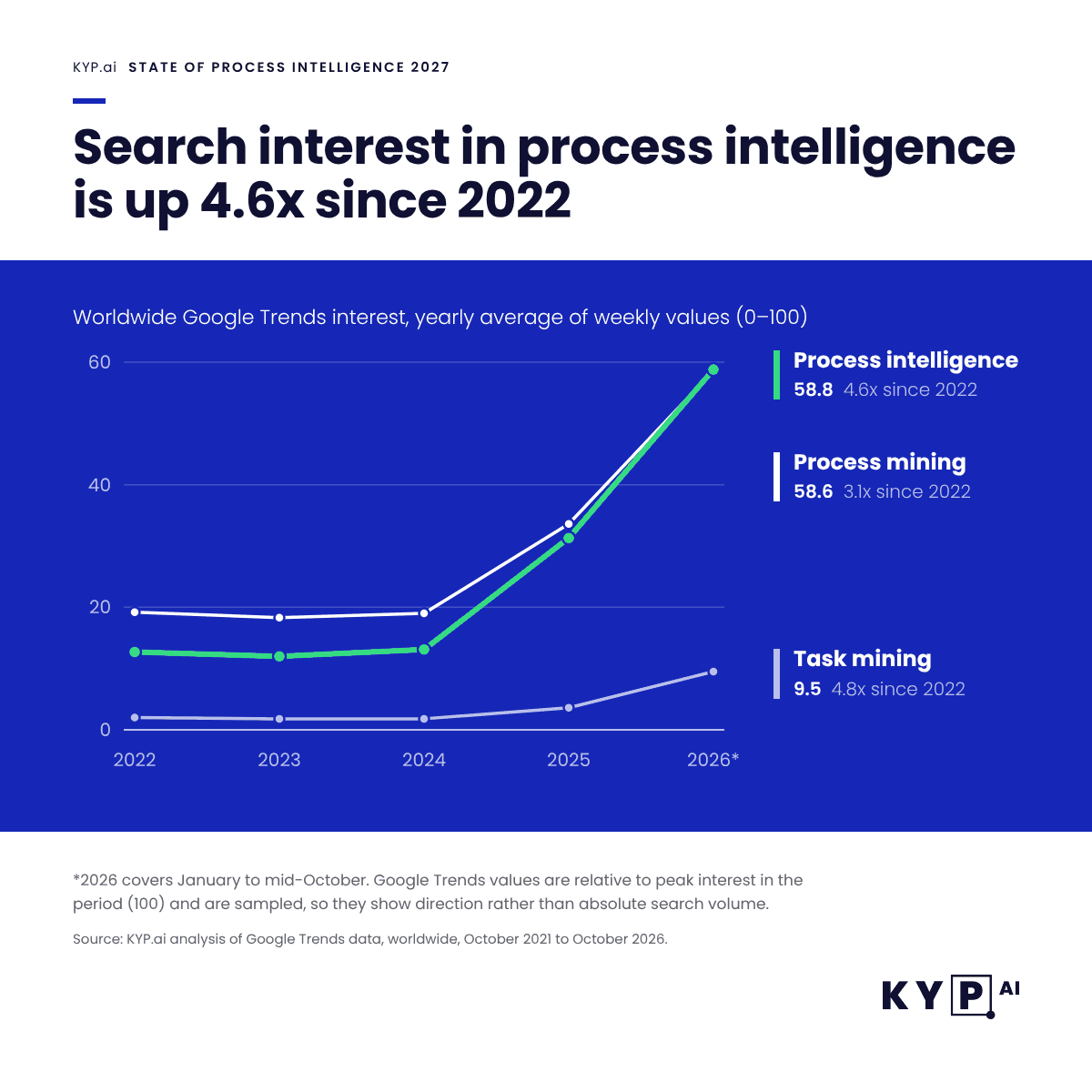
Worldwide search interest in process intelligence, process mining and task mining, yearly averages of Google Trends weekly values, 2022 to 2026
Key findings
- Process intelligence. Average weekly search interest in process intelligence reached 58.8 in 2026 (January to mid-October), up from 12.7 in 2022, a 4.6x increase.6
- Process mining. Average weekly search interest in process mining reached 58.6 in 2026, up from 19.2 in 2022, a 3.1x increase.6
- Task mining. Average weekly search interest in task mining rose from 2.0 in 2022 to 9.5 in 2026, a 4.8x increase from a much smaller base.6
- Process intelligence catches up. In 2022, process intelligence drew about two-thirds of the search interest of process mining. In 2026 the two terms draw the same level of interest.6
- Timing. Yearly averages stayed within a narrow band from 2022 to 2024 and stepped up from mid-2025, with peak weeks in May and June 2026. Weekly values are volatile, which is why the assessment uses yearly averages.6
KYP.ai assessment
Search interest shows where buyers start their research, and in 2026 they increasingly start from process intelligence. The convergence with process mining matches what buyers report: the question has moved from how to mine event logs to how to understand work well enough to automate it. Task mining remains the smallest term, consistent with desktop capture being absorbed into the broader process intelligence category.
3. How process intelligence helps prove ROI of AI in enterprise businesses
Enterprise AI adoption is close to universal, yet only a minority of organizations can show AI’s effect on revenue or EBIT. Research from 2025 and 2026 finds that the difference is rarely the model. The organizations reporting returns redesigned their workflows and measured how work ran before AI arrived. Process intelligence supplies that measured baseline, which is why proving the ROI of AI has become one of its main enterprise use cases.
Key findings
- Use and value. Nearly nine in ten organizations use AI regularly in at least one business function, yet only about four in ten (37%) report that AI has contributed positively to EBIT.7
- What high performers do differently. Only 6% of organizations qualify as AI high performers, with at least 5% of EBIT attributable to AI, unchanged from 2025. Nearly three-quarters of high performers have fundamentally redesigned workflows, against about one-quarter of other organizations.7
- Value is emerging, unevenly. Almost half of companies now generate value from AI, according to a 2026 index of more than 1,300 CxOs and senior leaders.8
- The CEO view. 56% of CEOs say they have realized neither revenue nor cost benefits from AI, in a survey of 4,454 CEOs in 95 countries and territories.9
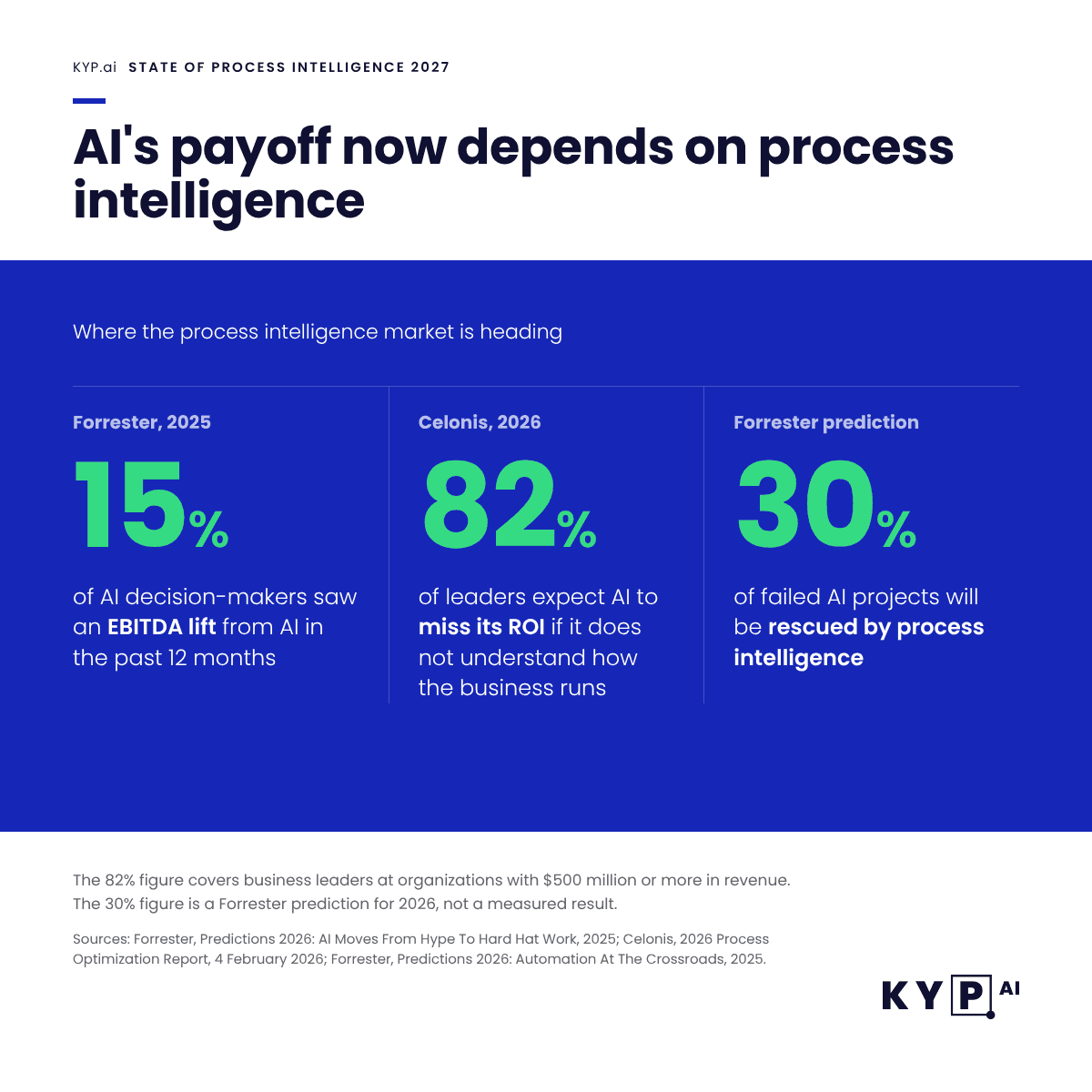
- Financial proof. Forrester reports that “Only 15% of AI decision-makers reported an EBITDA lift for their organization in the past 12 months and fewer than one-third can tie the value of AI to P&L changes.”10
- Investment outpaces gains. Nearly 90% of companies have invested in AI, but fewer than 40% report measurable gains.11
- ROI beyond the first use case. 74% of technology executives say their AI use cases deliver business value, but only 24% achieve ROI across multiple use cases.12
- Process understanding as a condition. 82% of decision-makers at organizations with $500 million or more in revenue believe AI will fail to deliver ROI if it does not understand how the business runs.13
- The most cited caveat. A widely cited 2025 study estimated that 95% of organizations get zero return from enterprise generative AI. Its authors describe the figure as directionally accurate and based on interviews, with no official company reporting behind it.14
KYP.ai assessment
Model capability is no longer the binding constraint on AI value. The organizations reporting returns changed how work flows before they scaled AI into it, and that change starts from a measured baseline of current work. Most organizations hold that baseline only for the steps their systems log. The rest is estimated in workshops, which is why business cases for AI so often fail to survive contact with finance.
4. Agentic AI adoption statistics: why AI agents stall before production
AI agents moved from experiment to budget line in most large enterprises during 2025 and 2026. Adoption surveys now measure a second gap, between agents in use and agents running inside end-to-end business processes in production. Across the studies, piloting is wide and production is narrow, and many agents operate in isolation from the processes they are meant to run. Surveys define adoption differently, from agents in production to agents being tested, so each figure is reported with its definition.
Key findings
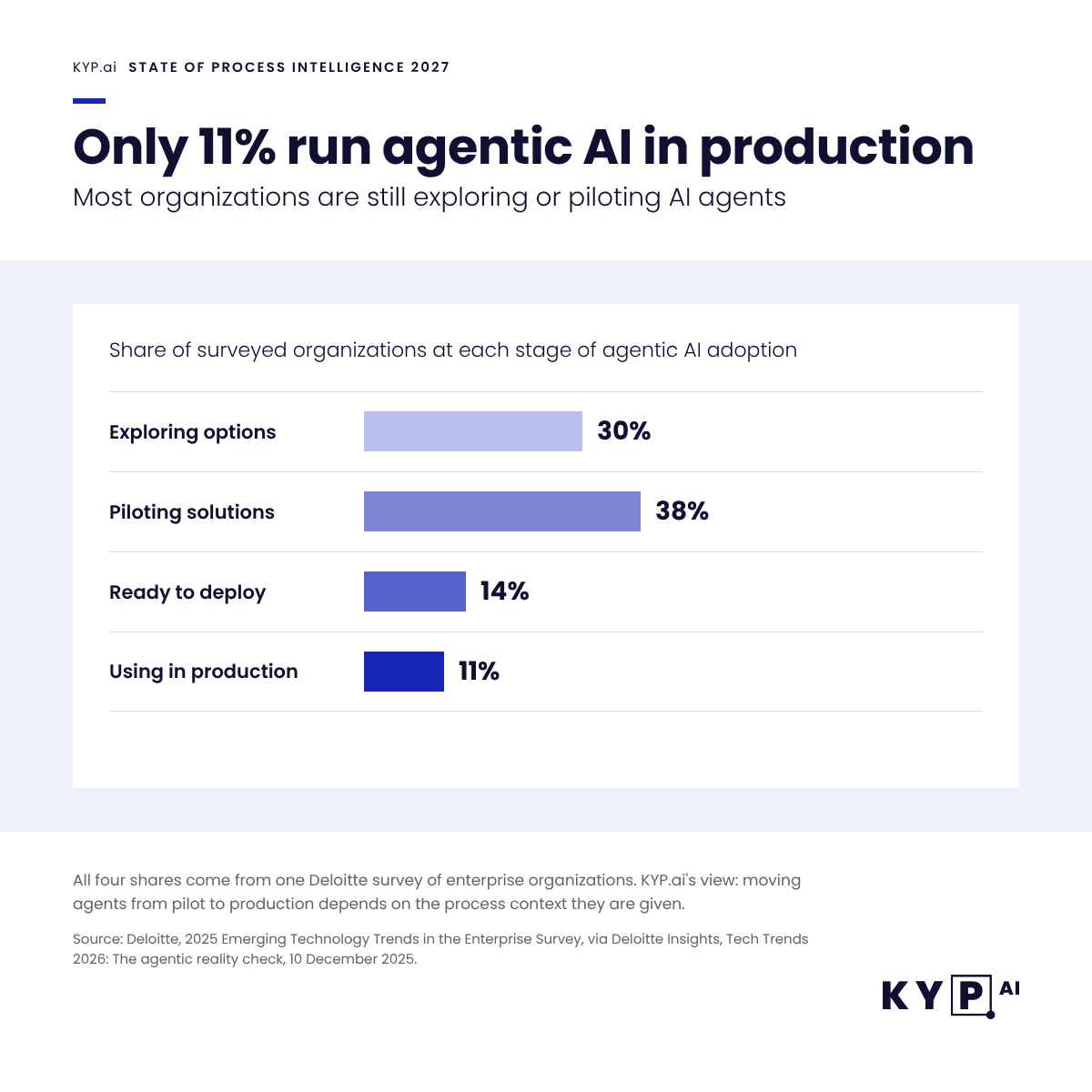
- Pilot to production. 38% of organizations are piloting agentic AI solutions, 14% have solutions ready to deploy and 11% are actively using them in production.15
- Use cases in production. Among 1,150 IT and business leaders surveyed in late 2025, 71% say their organizations use AI agents, yet only 11% of agentic AI use cases reached production in the past year.16
- Agents outside the process. 48% of those leaders say their AI agents operate in silos and are not woven into end-to-end business processes.16
- Multistep workflows. 59% of organizations have moved beyond piloting agentic AI, but only 9% have made progress building the autonomous, multistep workflows agentic AI is meant to enable.17
- Scale. Just 2% of enterprise organizations have deployed AI agents at scale and 12% at partial scale.18
- Isolated agents. Half (50%) of enterprise AI agents operate in isolated silos, outside any multi-agent system.19
- Active deployment. 54% of US organizations with $1 billion or more in revenue were actively deploying AI agents in early 2026.20
- Process intelligence’s place so far. Forrester observes that “process intelligence has largely sat out the first wave of agentic automation.”21
KYP.ai assessment
An AI agent placed inside an unchanged process inherits its exceptions and workarounds. Agents need the decision rules and edge cases that make up how a process really runs, and event logs record only part of that. Scaling agents in 2027 therefore depends on the quality of the process context an organization can give its agent platform, whichever platform it runs.
5. Process visibility: why documented processes differ from how work is actually done
Process maps and interviews describe how work is meant to run. A growing body of research measures how far that description sits from the work employees actually perform, through workarounds and labor that crosses systems. The findings show that most of the hidden cost, and most of the automation risk, sits in the gap between the documented process and the performed one.
Key findings
- Exceptions hide in descriptions. “When people describe their processes it all sounds very simple. But in reality, there are lots of exceptions,” says Wil van der Aalst, Distinguished Humboldt Professor at RWTH Aachen University and Chief Scientist of Celonis.22
- Processes as a constraint. 76% of enterprise decision-makers admit that their current processes are holding them back, and 58% of process and operations leaders report that their departments still do not operate seamlessly together.13
- Uncaptured cross-system work. Automating labor that spans multiple systems is a potential $100 billion market in the US, and more than 90% of it remains uncaptured.23
- Fragmented work. Nearly half of employees (48%) and more than half of leaders (52%) say their work feels chaotic and fragmented.24
- Fragmented time. Focus efficiency, the share of work time spent in focused and uninterrupted work, fell to 60%, a three-year low, and the average focus session lasts 13 minutes 7 seconds, based on behavioral data from 163,638 employees.25
- Lost hours. Employees lose nearly seven hours a week to complicated processes and fragmented tools.26
KYP.ai assessment
The distance between documented and performed work is where both the improvement value and the automation risk sit. Interviews and process maps capture the documented version. Observed task-level data captures the performed version, including the exceptions that make simple-sounding processes expensive. Organizations that plan AI on the documented version are automating a process that does not exist. Closing that distance is ongoing work, because the performed process keeps changing, which is why automated process discovery matters more each year.
6. Data and system integration challenges that hide work between applications
Enterprise work runs across hundreds of applications, and most of them are not integrated with each other. Each system logs its own steps, while the work that links them is done by people moving between screens. Integration and data-readiness research shows how app sprawl and unready data limit both AI programs and any process analysis that relies on system logs alone.
Key findings
- Application sprawl. The average number of applications in an enterprise grew from 897 to 957 in a year, and only 27% of them are integrated with each other.19
- Integration as a condition for agents. 96% of IT leaders agree that AI agent success depends on seamless data integration across all systems.19
- Data readiness gap. 64% of enterprises leading in agentic AI rate their data ready, compared with 9% of laggards.27
- Finding and reusing data. Nearly half of organizations cite searchability of data (48%) and reusability of data (47%) as challenges to their AI automation strategy.15
- Piecemeal technology. Half (50%) of CEOs say the pace of recent technology investment has left their organization with disconnected, piecemeal technology.28
- Barriers to scaling agents. Data quality and readiness (38%), integration of agentic AI with existing workflows and systems (37%), and governance and compliance (33%) are the top barriers to scaling agentic AI.29
- Incomplete data. 73% of companies report challenges with incomplete data.30
KYP.ai assessment
When most applications are unintegrated, the end-to-end process is assembled by people moving between them. That connective work appears in no single system’s log, so system-centric analysis sees each application clearly and the process between them poorly. Integration programs will narrow the gap over time. In the meantime, the only complete record of a cross-application process is the work as people perform it.
7. Process intelligence implementation challenges: why programs stall
Process intelligence implementation is less studied than AI adoption, and much of the published data is older. The barriers it documents concern executive sponsorship and knowing where to start more than the technology itself. Practitioner evidence also shows that value fades when analysis stops after the first report.
Key findings
- Sponsorship. Lack of management support is cited as a barrier to process mining by 41% of organizations, up from 26% in 2021.5
- Priority and budget. Lack of priority is reported by 29% of organizations (48% in 2021) and budget constraints by 24% (26% in 2021).4
- Knowing where to start. 67% of Global 2000 executives named a lack of knowledge about which processes would benefit as the biggest challenge for process intelligence adoption, and at most 29% of process intelligence engagements had been scaled up and industrialized, in a 2022 study of 400 executives.31
- Process maturity. 85% of IT and business leaders say they have not yet reached the right level of process maturity to implement agentic orchestration, and 85% say they need better tools to manage the intersections between processes.16
- Business context. Internal expertise (47%) and the difficulty of getting AI to understand business context (45%) are the top two barriers to enterprise AI adoption.13
- Results fade without monitoring. “If you write a nice report and then walk away, the process reverts back,” says Wil van der Aalst.22
KYP.ai assessment
The documented barriers point to the start and the finish of a program. At the start, teams struggle to choose where process intelligence will pay, and sponsorship weakens while they decide. At the finish, a one-time analysis decays as the process drifts back. Programs that survive both tend to reach a defensible business case early and keep measuring afterwards. Time to first insight is therefore a selection criterion in its own right.
8. AI agent governance and trust: how controls lag deployment
AI agent governance covers the controls and audit trails that let organizations trust agents with business processes. Surveys from 2025 and 2026 show organizations deploying agents faster than they build those controls, while trust in fully autonomous agents falls as adoption rises. Process data that records how work should run, and how it actually ran, is one of the foundations of that governance.
Key findings
- Mature agent governance. Only one in five companies has a mature model for governing autonomous AI agents.32
- Human validation. The share of large US organizations that require human validation of AI agent outputs rose from 22% in early 2025 to 63% in early 2026.20
- Falling trust. Trust in fully autonomous AI agents fell from 43% to 27% in one year.18
- Core processes. Only 6% of technology decision-makers say their organization trusts agentic AI to handle core business processes.33
- Controls in place. Only 5% of companies have the full set of critical controls for AI agents in place.8
- Centralized oversight. Only 54% of organizations have a centralized governance framework with formal oversight of their agentic capabilities.19
- Transparency. 80% of IT and business leaders are concerned about a lack of transparency into how AI is used, and 84% worry about the business risk of AI in day-to-day processes without proper IT controls.16
- Agent inventories. Only 44% of businesses keep a registry of the AI agents they run, and 38% have no human-in-the-loop process for agentic workflows.30
KYP.ai assessment
Governing an agent requires two things most organizations lack. One is a reference for how the process should run. The other is a way to see when execution drifts from it. Both come from process data that is continuous and auditable. That data describes people’s work, so it has to be governed as carefully as the agents it supervises.
9. Task-level work and the workforce impact of AI automation
Research on AI and work has moved from whole jobs to individual tasks. Current estimates cover how much work is technically automatable and how tasks are split between people and technology today. They show value concentrating at the task level while most roles have not been redesigned to match, which makes task-level measurement the basis for workforce planning.
Key findings
- Technical potential. Today’s technology could, in theory, automate about 57% of current US work hours. The estimate measures technical potential and does not forecast job losses.11
- Who does the task. 47% of work tasks are performed mainly by humans alone, 22% mainly by technology and 30% by a combination of both. Employers expect the three to be nearly evenly split by 2030.34
- AI-supported tasks. About 30% of tasks in the average business are supported by AI, a share expected to rise to 48% within two years.30
- Rework. Nearly 40% of AI time savings are lost to rework, and in 89% of organizations fewer than half of roles have been updated to reflect AI capabilities.35
- Employee readiness. 84% of US desk workers are eager to embrace agentic AI in their roles, while 56% worry about their own job security.36
- Regular use. CEOs estimate that only 25% of their workforce uses AI regularly at work, although 86% believe their employees have the skills to collaborate with AI.37
KYP.ai assessment
When value sits in tasks, a role-level view of work is too coarse to plan with. Leaders need to know which tasks consume capacity and how long those tasks take across applications. That evidence also changes the workforce conversation. It lets leaders decide which work to redesign and where to redeploy the capacity it frees.
10. Executive priorities for AI and operations in 2027
Executive surveys from 2025 and 2026 show leaders creating new AI roles and expecting AI to reshape how work gets done. They also show limited alignment on what AI should solve. These priorities set the budget and accountability context in which process intelligence programs get approved.
Key findings
- New owners. 76% of organizations have a Chief AI Officer in 2026, up from 26% in 2025.37
- Redesign pays. Organizations that redesigned five core business areas (technology, finance, HR, operations and cross-functional collaboration) are four times more likely to have delivered on business objectives.37
- Operating model change. Even among US companies adopting AI agents, fewer than half are fundamentally rethinking operating models and how work gets done (45%) or redesigning processes around AI agents (42%).38
- Leadership alignment. Only one in four AI users (26%) say their leadership is clearly and consistently aligned on AI.39
- Operations under pressure. 61% of operations leaders say day-to-day operations prevent their company from focusing on the future.40
KYP.ai assessment
Leaders agree that the operating model has to change and disagree on where to begin. A shared, measured picture of how work runs today is the most practical way to settle that disagreement, because it turns competing opinions about priorities into a comparison of quantified opportunities. That picture also gives a new AI owner something every transformation needs on day one: a baseline.
11. Process intelligence and agentic AI predictions for 2027 to 2030
Forecasts published in 2025 and 2026 treat 2027 as the year AI investment is held to account. They come from analysts, consultancies and CEO surveys. Together they predict rising spending on agentic AI alongside deferred budgets and narrow production rates, and they point to process visibility as one of the capabilities that decides which projects survive.
Key findings
- Process intelligence as a recovery path. Forrester predicts that “Process intelligence will rescue 30% of failed AI projects” and that “Less than 15% of firms will turn on the agentic features in intelligent automation suites.”21
- Deferred spend. Forrester predicts that enterprises “will defer a quarter of their planned AI spend into 2027.”41
- CEO expectations for 2027. 85% of CEOs expect their investments in scaled AI efficiency and cost savings to have returned a positive ROI by 2027.28
- Agentic pilots. A quarter of companies using generative AI were expected to launch agentic AI pilots or proofs of concept in 2025, a share forecast to grow to half by 2027.42
- Services become software. 75% of Global 2000 enterprises plan to replace people-run services with software-run services by 2028.43
- Autonomous decisions. By 2030, CEOs expect 48% of operational decisions that can be codified with consistency and guardrails to be made by AI without human intervention, compared with 25% today.37
- Share of IT budgets. Agentic AI is forecast to exceed 26% of worldwide IT spending, reaching $1.3 trillion in 2029.44
KYP.ai assessment
The forecasts describe a sorting year. Spending on agents keeps rising while budgets are deferred and few use cases reach production. The projects that survive will be the ones that can show what they changed in a measured process and what that change was worth. Prediction after prediction points to the same capability: knowing how work actually runs before and after AI arrives.
What the research means for process intelligence in 2027: KYP.ai’s view
Process intelligence in the agentic era is human-grounded. Or it isn’t process intelligence. It’s reporting.
Event logs, interviews, documentation and surveys are proxies for how work gets done. They were adequate for optimizing software. Agents raise the bar, because they have to learn how work actually happens, including the exceptions and the steps between applications. The research points to three requirements for 2027.
- See the work as performed. KYP.ai’s 360 Enterprise View captures and correlates process, people and technology data in real time, across every desktop and application. It includes task mining and process mining in one platform, so the steps between systems appear alongside the steps inside them.
- Decide what should change, not only what could. The Business Transformation Engine quantifies inefficiencies and calculates automation ROI for each opportunity, so every initiative arrives with a business case. Teams can model the numbers for their own operation with the KYP.ai ROI calculator.
- Give agents context they can act on. The Agentic AI Enabler delivers business context, action details and production-ready agent code. Through MCP, KYP.ai exposes process intelligence as a structured data source any LLM can query at runtime. The agent code is platform agnostic by design, deployable on UiPath, SAP Joule, n8n, Camunda, Power Automate, WatsonX, Blue Prism, Anthropic, ServiceNow, CrewAI or whatever platform an organization already runs. No lock-in.
Put simply, KYP.ai is process mining + task mining in one platform for full work visibility, and the process intelligence layer for agentic AI readiness. It is privacy-by-design. Sensitive data is anonymized at source, on the workstation, before it ever leaves the device. Granular configuration lets organizations define exactly what is and is not captured, and the platform is GDPR compliant, with SOC2 Type II and ISO27001 certification. Deployment follows four milestones: setup in minutes, live in days, statistically relevant insights in 3 weeks and measurable returns in 90 days.
Qatar Airways GBS reached a self-funded ROI in two months, against an industry norm of 18–24 months. Digital presence rose from under 50% to over 84% after deployment, inside a $100 million targeted benefits program. The team used KYP.ai to see the work and built the business case in public with Finance. As John Adamek of Qatar Airways put it: “Process intelligence shows you the truth. AI helps you act on it. Finance helps you fund it.”
Bottom line
The research converges on one conclusion for 2027. AI value depends on how well an organization understands and redesigns its own work, and agentic AI makes that dependency harder to ignore.
- Process intelligence is now judged as the context layer for AI, so task-level visibility belongs in every platform evaluation.
- Workflow redesign separates the organizations reporting AI returns from the rest, and redesign starts from a measured baseline.
- Agents scale only as far as the process context they receive, which makes observed work data part of the agent stack.
- Agent governance depends on continuous, auditable process data that is itself collected with privacy-by-design.
Most environments are live within days. Book a demo to see what that looks like for yours.
Frequently asked questions about the state of process intelligence
Process intelligence is an established enterprise software category whose purpose is increasingly defined as supplying operational context to AI. Adoption of AI is widespread, but value at scale remains limited to a minority of organizations, and the research links that gap to how well organizations understand and redesign their work. KYP.ai’s State of Process Intelligence 2027 assessment summarizes the published research behind that view.
The global process intelligence platforms market is estimated at $8.8 billion in 2026 and is expected to reach $32.4 billion by 2034.1 Estimates for the process mining segment start at $5.45 billion in 2026.2 Published figures vary widely because research firms define the category differently.
Yes. KYP.ai’s analysis of worldwide Google Trends data shows average weekly search interest in process intelligence rising 4.6x between 2022 and 2026, to the same level as process mining.6
Process mining reconstructs processes from the event logs that enterprise systems record. Process intelligence is the broader category that combines mining with process modeling, task-level capture of work performed at the desktop, monitoring and analysis of improvement and automation opportunities.
An agent acts on the process context it is given, including the decision rules and exceptions that define how work really runs. Event logs capture only the steps that systems record, so agents trained on them miss the work people perform between applications. Process intelligence supplies that context and a baseline for measuring whether the agent improved the process.
AI use is widespread while measurable financial value is concentrated in a minority of organizations. The organizations reporting returns are much more likely to have redesigned workflows around AI.7 Without a measured baseline of current work, AI is often added to a process nobody has fully mapped, and the business case cannot be proven.
The answer depends on how adoption is defined. 54% of large US organizations were actively deploying AI agents in early 2026,20 but only 2% of organizations have deployed agents at scale.18
Few. Only 11% of agentic AI use cases reached production in the past year,16 and only 11% of organizations actively use agentic AI systems in production.15
Cite it as KYP.ai, State of Process Intelligence 2027: KYP.ai market assessment (October 2026). Each finding in the assessment links to its original source in the numbered notes.
How this assessment was conducted
KYP.ai compiled this assessment from published research by four groups of sources:
- Analyst and market research firms, including Forrester, IDC, Everest Group, HFS Research, Stratistics MRC and Fortune Business Insights.
- Consultancies and research institutes, including McKinsey, Deloitte, PwC, KPMG, BCG, Capgemini, Bain, EY, MIT and the World Economic Forum.
- Software vendors in process, automation, data and integration, including Camunda, ServiceNow, UiPath, SAP, IBM, Celonis, Salesforce (MuleSoft), Microsoft and Workday.
- Google Trends search data, analyzed by KYP.ai.
Inclusion rules for every finding:
- Each figure was checked against the publisher’s own page, or against named trade coverage where the original report is gated.
- Research published in 2025 and 2026 is preferred. Older figures appear only as baselines and carry their year.
- Each finding is stated in KYP.ai’s words and carries a numbered note that links to the original source, its date and, where disclosed, its sample and fieldwork firm.
- Direct quotes keep the name of the person or firm quoted.
- Forecasts are labeled as forecasts.
- Search trend figures are yearly averages of Google Trends weekly values, worldwide, from October 2021 to October 2026. Google Trends values are relative to peak interest in the period and are sampled, so they indicate the direction of interest. They do not measure absolute search volume.
Last verified: October 2026.
How to cite this assessment: KYP.ai, State of Process Intelligence 2027: KYP.ai market assessment (October 2026).
Sources
- Stratistics MRC, Process Intelligence Platforms Market Forecasts to 2034, via MarketResearch.com, 21 May 2026.
- Fortune Business Insights, Process Mining Software Market Size, Share and Industry Analysis, last updated 5 October 2026.
- Everest Group, Process Mining Products PEAK Matrix Assessment 2025, 16 June 2025.
- Process Excellence Network, 6 takeaways from the Deloitte Global Process Mining Survey 2025, 2025. More than 120 respondents.
- Deloitte, Global Process Mining Survey 2025, 27 February 2025.
- KYP.ai analysis of Google Trends data for process intelligence, process mining and task mining, worldwide, weekly values from October 2021 to October 2026, retrieved 21 October 2026.
- McKinsey, The state of AI in 2026: On the road to ROI, 25 August 2026. Online survey of 1,719 participants in 97 nations, 4 May to 8 June 2026.
- BCG, The Formula for Agentic AI Value, September 2026. Survey of more than 1,300 CxOs and senior leaders.
- PwC, 29th Global CEO Survey, January 2026. 4,454 CEOs in 95 countries and territories, 30 September to 10 November 2025.
- Forrester, Predictions 2026: AI Moves From Hype To Hard Hat Work, Forrester blog, 2025.
- McKinsey Global Institute, Agents, robots, and us: Skill partnerships in the age of AI, 25 November 2025.
- KPMG International, Global Tech Report 2026, 22 January 2026. 2,500 executives in 27 countries.
- Celonis, 2026 Process Optimization Report, 4 February 2026. 1,649 interviews by Insight Avenue, commissioned by Celonis, June to July 2025.
- MIT NANDA, The GenAI Divide: State of AI in Business 2025, July 2025. Preliminary findings from 52 interviews, 153 survey responses and a review of more than 300 public initiatives.
- Deloitte Insights, Tech Trends 2026: The agentic reality check, 10 December 2025.
- Camunda, 2026 State of Agentic Orchestration and Automation, 14 January 2026. Commissioned by Camunda, fielded by Coleman Parkes, 1,150 respondents in the US, UK, France and Germany, 23 September to 23 October 2025.
- ServiceNow, Enterprise AI Maturity Index 2026, 15 June 2026. 4,500 executives and 2,000 employees across 19 countries.
- Capgemini Research Institute, Rise of agentic AI: How trust is the key to human-AI collaboration, 16 July 2025. 1,500 senior executives in 14 countries.
- Salesforce and MuleSoft, Connectivity Benchmark Report 2026, 5 February 2026. Vanson Bourne survey of 1,050 IT leaders, October to November 2025.
- KPMG US, Q1 2026 AI Quarterly Pulse, 31 March 2026. 237 US leaders at organizations with $1 billion or more in revenue.
- Forrester, Predictions 2026: Automation At The Crossroads, Forrester blog, 2025.
- IT Brief Australia, Exclusive: The ‘godfather of process mining’ on its past and future, 28 August 2025. Interview with Wil van der Aalst.
- Bain & Company, The $100-Billion SaaS Opportunity Hiding in Cross-System Labor, 7 May 2026.
- Microsoft, Breaking down the infinite workday, Work Trend Index, 17 June 2025.
- ActivTrak Productivity Lab, 2026 State of the Workplace, 11 March 2026. Behavioral data from 163,638 employees at 1,111 companies.
- Freshworks, 20% of Software Budgets Wasted on Unnecessary Business Complexity, 10 November 2025. Survey of 706 practitioners and decision-makers in six countries.
- HFS Research, Agentic AI scales when enterprises own the outcome and redesign the work, 12 October 2026. 302 enterprise leaders, September 2026, with IBM and Microsoft.
- IBM Institute for Business Value, 2025 CEO Study, 6 May 2025. 2,000 CEOs in 33 countries, with Oxford Economics.
- UiPath, AI Adoption and Orchestration Survey 2026, 9 September 2026. 590 C-suite and IT practitioners at companies with $1 billion or more in revenue.
- SAP and Oxford Economics, Value of AI Report 2026, 15 July 2026. 2,600 business leaders in 13 countries.
- HFS Research with Genpact, The meteoric rise of process intelligence, 3 October 2022. 400 Forbes Global 2000 executives.
- Deloitte AI Institute, The State of AI in the Enterprise, 2026. 3,235 senior leaders in 24 countries, August to September 2025.
- Harvard Business Review Analytic Services, sponsored by Workato, From the Edge to the Core: Bringing Agentic AI to the Heart of the Enterprise, December 2025. 603 respondents, July 2025.
- World Economic Forum, Future of Jobs Report 2025, 7 January 2025.
- Workday, New Workday Research: Companies Are Leaving AI Gains on the Table, 14 January 2026. Hanover Research survey of 3,200 employees, November 2025.
- EY US, Agentic AI workforce survey, 23 October 2025. 1,148 US desk workers.
- IBM Institute for Business Value, 2026 CEO Study, 4 May 2026. 2,000 CEOs in 33 geographies, with Oxford Economics.
- PwC US, AI Agent Survey, 16 May 2025. 308 US executives, 22 to 28 April 2025.
- Microsoft, Work Trend Index 2026: Agents, human agency, and the opportunity for every organization, 5 May 2026. Edelman Data x Intelligence survey of 20,000 AI users in 10 markets.
- PwC US, Pulse Survey: COO and operations leaders, June 2024.
- Forrester, Forrester’s 2026 Technology & Security Predictions, 28 October 2025.
- Deloitte, TMT Predictions 2025: Autonomous generative AI agents, 19 November 2024.
- HFS Research, CIOs can close the gap between AI ambition and enterprise production, 8 June 2026.
- IDC, Agentic AI to Dominate IT Budget Expansion Over Next Five Years, 26 August 2025.
Get your process intelligence with the ROI attached - Book a demo!
Book Demo

 Szymon Kozak


 Wojciech Zytkowiak-Wenzel



 Adam Bujak

 Felix Haeser