By the time a leadership team reaches the “go build agents” decision, the hard questions should be in front of them: How will this change how we actually run the business? Who owns the outcomes? How will we know if enterprise agentic AI is working beyond the demo? The organizations that are starting to pull ahead are not those with the most pilots; they’re the ones that treat agentic AI as an execution discipline, not a technology experiment.
From Strategy Slideware to Operational Reality
Most enterprises now have some version of an AI strategy: a vision slide, a list of use cases, maybe even a center of excellence. That is not what separates winners from everyone else. The gap opens up in the execution layer—how ideas move from slideware into production, how long they stay there, and whether they actually generate AI ROI that shows up in financials.
A familiar pattern appears in organizations stuck in perpetual pilot mode. AI initiatives are scattered across functions with no clear owner, success is defined in technical terms rather than business outcomes, and there is no consistent way to move from “interesting prototype” to “operational capability.” In that environment, even a strong enterprise agentic AI strategy will quietly stall.
The companies breaking that pattern have made a simple but demanding shift: they treat enterprise agentic AI as an operating model change. That means assigning accountable owners, building the right process intelligence foundations, and designing governance before agents touch production.
The Operating Model for Enterprise Agentic AI
If agentic AI is going to become part of how the enterprise runs, not just a series of isolated experiments, it needs a clear operating model.
At a minimum, that model has to answer four questions:
- Who decides where agents are deployed first?
- Who is accountable for AI ROI in each domain?
- How are risks managed without destroying speed?
- How do learnings from one agent benefit the next?
A practical pattern emerging across high-performing organizations includes:
- A cross-functional steering group that sets priorities, approves investments, and resolves trade‑offs between risk and speed.
- Domain owners (finance, operations, customer service, supply chain) accountable for AI ROI outcomes in their areas, not just “AI activity.”
- A central team owning the process intelligence platform, common tooling, standards, and reference architectures.
- Embedded experts in key business units who translate between process reality and agent design.
In this model, enterprise agentic AI is not a standalone program; it is a capability that plugs into the way the business already makes decisions about capital allocation and operational change.
Why Process Intelligence Platforms Sit at the Center
If Chapter 2 was about why context beats compute, the execution challenge is making that context consistently available to every agent you deploy. That is what elevates a process intelligence platform from a useful tool to a central part of the operating model for enterprise agentic AI.
In practice, a process intelligence platform becomes three things at once:
- The x‑ray of your operations: showing how work really flows, where it breaks, and how it varies by region, product, or customer segment.
- The source of truth for readiness: making it clear which processes are ready for agents and which need redesign or data work first.
- The telemetry hub: capturing how agent decisions change behavior, cycle times, and outcomes over time so AI ROI can be measured and improved.
Without this foundation, every new use case starts from guesswork. With it, each deployment builds on a shared operational understanding and feeds back data that improves the next decision. Process intelligence platforms make AI ROI visible and defensible by connecting agent activity to business-level outcomes.
Governance That Enables, Rather Than Blocks
Governance often enters the conversation as a brake pedal – necessary to prevent risk, but frequently experienced as the thing that slows everything down. In a world of enterprise agentic AI, that mindset has to change. The goal is not to wrap agents in red tape; it is to design a lightweight system that allows them to operate safely at scale.
Effective governance for agentic AI typically includes:
- Clear decision boundaries: which actions agents can take autonomously, which require human approval, and which are off limits.
- Risk tiers for use cases: low‑risk, high‑volume processes can move faster; high‑risk, sensitive processes follow a more rigorous path.
- Standard approval patterns: so every new agent doesn’t invent its own way of handling escalations, overrides, and exceptions.
- Auditability by design: making sure decisions are traceable and explainable without turning the system into a compliance-only exercise.
When governance is grounded in real process intelligence – rather than generic policies – it becomes an accelerator. Teams know what’s allowed, what data is required, and how to move from idea to deployment without starting from zero each time.
From Projects to a Continuous Delivery Rhythm
Many early AI programs were structured as traditional projects: long planning phases, big launches, and then a search for impact. Enterprise agentic AI works better when it follows a product‑like rhythm – small increments, frequent releases, continuous improvement.
A healthy delivery cadence often looks like this:
- Quarterly planning to select a handful of high‑impact domains and define the AI ROI targets.
- Short design and discovery cycles using a process intelligence platform to understand current reality and identify where agents can help.
- Phased rollouts: starting in copilot mode, then constrained autonomy, then wider autonomy as confidence grows.
- Regular reviews where domain owners, operations, and the central AI team look at performance, incidents, and opportunities to expand or adjust.
This rhythm turns enterprise agentic AI from a series of one‑off launches into a continuous capability that gets stronger with each iteration.
The Human Side: Roles, Skills, and Trust
No operating model for enterprise agentic AI works without people who understand both the technology and the business. That doesn’t just mean hiring more data scientists. It means shaping new hybrid roles and upskilling existing talent.
Three roles are becoming critical:
- AI‑literate process owners: people who understand their domain deeply and can think in terms of agents, constraints, and AI ROI, not just headcount and SLAs.
- Process intelligence specialists: experts who can turn raw operational data into usable maps, metrics, and insights that feed agent design using process intelligence platforms.
- AI orchestrators / product owners: individuals responsible for the lifecycle of specific agents or portfolios of agents, from initial design through monitoring and improvement.
Trust is the other side of this. Frontline teams will not embrace agents they see as opaque, fragile, or imposed without explanation. Early wins, clear guardrails, transparent performance data, and genuine involvement in design all contribute to building trust.
Making AI ROI Visible and Defensible
In the end, enterprise agentic AI will be judged by the same standard as any other significant investment: does it create durable value? That means being able to answer questions like:
- How has this changed cycle times, error rates, and throughput in specific processes?
- What cost savings or capacity gains has it generated—after accounting for build and run costs?
- How has it affected revenue, customer satisfaction, or risk exposure?
A process intelligence platform helps here by linking agent actions to process performance and by providing before‑and‑after comparisons grounded in actual execution data. Instead of hand‑waving about “efficiency,” leaders can show how enterprise agentic AI reshaped concrete workflows and outcomes, making AI ROI both visible and defensible to boards and stakeholders.
This visibility doesn’t just justify past investments. It also informs the next wave of decisions—where to double down, where to pause, and where to redesign.
What Leaders Need to Put in Place Now
For leadership teams, making enterprise agentic AI work is less about buying the next model and more about building the scaffolding that lets agents operate at scale. The priorities are increasingly clear:
- Define the operating model: who owns priorities, outcomes, and risk decisions for agentic AI across the enterprise.
- Commit to a process intelligence platform as a core capability: not a project add‑on, but the backbone that grounds every agent.
- Design governance that scales: simple, repeatable patterns for approvals, risk management, and oversight.
- Shift to a continuous delivery mindset: treating agents as evolving products, not static deployments.
- Invest in people: upskill process owners, create hybrid roles, and bring operations into the design loop early.
The organizations that do this now will find that each new agent gets easier to deploy, easier to trust, and easier to prove out in financial terms. Those that don’t will stay stuck in an endless cycle of impressive demos, isolated pilots, and hard questions from boards about where the AI ROI went.
Want the complete blueprint for making enterprise agentic AI work end‑to‑end?
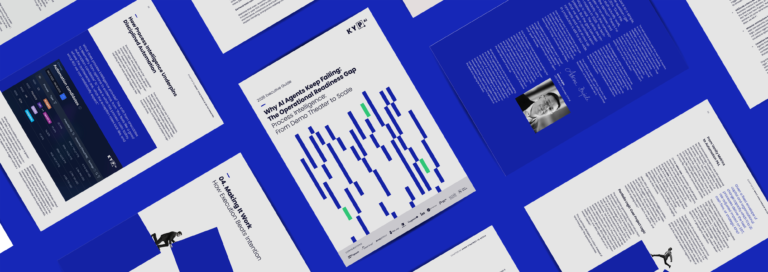
The full white paper, “Why AI Agents Keep Failing: The Operational Readiness Gap,” walks through the entire journey – from the agentic inflection point to grounding, prioritization, and execution – with detailed frameworks, real‑world patterns, and a roadmap for building process intelligence foundations that deliver sustainable AI ROI.
FAQ / Common Questions About Enterprise Agentic AI Execution
How do you build an operating model for enterprise agentic AI?
A successful operating model requires four elements: a cross-functional steering group to set priorities and manage trade-offs, domain owners accountable for AI ROI in specific areas, a central team managing the process intelligence platform and standards, and embedded experts who translate between process reality and agent design. This structure treats agentic AI as a business capability, not an IT project.
What role does a process intelligence platform play in AI governance?
Process intelligence platforms provide the operational foundation for effective governance by revealing how work actually flows, where risks concentrate, and which processes are ready for automation. This grounds governance in reality rather than generic policies, enabling teams to set appropriate decision boundaries, design risk tiers, and maintain auditability without creating bureaucratic bottlenecks that slow deployment.
How do you measure AI ROI across multiple agent deployments?
Measure AI ROI by linking agent activity to business-level outcomes using process intelligence platforms: cycle time reductions, cost per transaction changes, throughput improvements, and customer satisfaction impact. Track these metrics before and after deployment to prove value. Organizations achieving strong AI ROI measure process-level outcomes across the full workflow, not just technical metrics like “tasks automated” in isolated steps.
What skills do teams need to execute enterprise agentic AI successfully?
Three critical roles drive successful execution: AI-literate process owners who understand their domains and can design for agent capabilities, process intelligence specialists who turn operational data into actionable insights, and AI orchestrators who manage agent lifecycles from design through continuous improvement. Upskilling existing talent in these hybrid roles often delivers better results than hiring external specialists without domain knowledge.
When should you invest in a process intelligence platform for agentic AI?
Invest before scaling enterprise agentic AI deployments. Process intelligence platforms are essential infrastructure for understanding operational readiness, grounding agents in how work truly happens, and measuring AI ROI across deployments. Organizations that treat these platforms as “nice-to-have” rather than foundational struggle with agent failures, governance gaps, and inability to prove returns on AI investments.
Discover Your Productivity Potential – Book a Demo Today
Book Demo

 Adam Bujak


 Wojciech Zytkowiak-Wenzel
 Frank Scheuble
  Miroslaw Bartecki
 Kamil Newczynski