Most enterprises now agree that automation is back on the strategic agenda. Except that this time, it is powered by enterprise agentic AI instead of scripts and static workflows. The hard part is no longer whether agents can automate something. The hard part is deciding what they should automate, in what order, and under which conditions, so that impact actually reaches the P&L rather than dying in a dashboard.
The Leftover RPA Problem
Many organizations are quietly living with a hangover from the last automation wave. Previous generations of RPA and workflow tools were often pointed at whatever looked easy to automate, not what truly mattered to the business. The result: dozens or hundreds of brittle bots, each shaving seconds off tasks no one cares about, while core processes remained complex, manual, and opaque.
Enterprise agentic AI risks repeating the same pattern at a higher level of sophistication. If the selection logic doesn’t change, you simply build smarter agents to automate low‑value work. The technology looks more impressive, the business impact doesn’t. This is how companies end up with AI programs that are busy but not transformative.
The first discipline of this new wave is restraint. Just because an agent can handle a task does not mean it should.
From Task Shopping Lists to Investment Decisions
The default way many organizations approach automation is still bottom‑up: teams submit lists of tasks they’d like to see automated, vendors add more “use case ideas,” and the pipeline quickly fills with dozens of scattered opportunities. It feels productive, but it’s a poor way to allocate capital or drive meaningful AI ROI.
A better approach treats agentic AI as an investment portfolio. Instead of collecting tasks, leaders ask three questions about each candidate process or domain:
- Impact – If this worked perfectly, how much could it move cost, revenue, risk, or experience?
- Readiness – Do we actually understand this process, its data, and its constraints well enough to expose it to an agent?
- Risk – What is the downside if the agent gets it wrong, and how easily can humans intervene?
High‑impact, high‑readiness, manageable‑risk areas go to the top of the list. Low‑impact or low‑readiness areas wait, no matter how tempting they look in a demo.
Three Layers of Work to Evaluate
When you examine real jobs through the lens of enterprise agentic AI, most roles break down into three layers of work. Thinking in these layers helps avoid both over‑ and under‑automation while maximizing returns.
1. Routine, Rules‑Heavy Work
This is the work that should have been automated years ago but often wasn’t: validation checks, standard approvals, data enrichment, simple routing, status updates, and other repetitive tasks that follow clear patterns.
Agentic AI is particularly effective here when supported by process intelligence. Agents can monitor queues, trigger actions, handle standard cases end‑to‑end, and apply consistent rules at scale while reducing errors and variance. These are usually safe, high-ROI starting points; as long as the underlying process and data are well understood.
2. Structured Decision‑Making
The second layer covers decisions that are more complex than a simple rule, but still grounded in clear criteria: credit decisions within defined thresholds, prioritization of cases, exception handling under known conditions, or recommending next best actions to human operators.
Agents can take on a significant share of this work by evaluating options against codified policies, proposing decisions with confidence scores and explanations, and escalating ambiguous or high‑risk cases to humans with context attached.
Here, the goal isn’t full autonomy from day one. It’s progressive autonomy—starting with “copilot” behavior and gradually expanding responsibility as the system proves itself and the process model matures. This staged approach protects returns while building organizational trust.
3. Judgment‑Heavy, Contextual Work
At the top layer sit decisions and interactions that rely on deep context, negotiation, or organizational intuition: handling sensitive customer escalations, designing new policies, resolving cross‑functional trade‑offs, or navigating political and ethical complexities.
Agents can still play a role here, but as amplifiers rather than owners. They prepare decision briefs, synthesize data and policy into situational awareness, and capture the reasoning behind human decisions to refine future guidance. Trying to fully automate this layer too early is a fast way to create backlash and risk.
How Process Intelligence Platforms Change the Automation Map
On slides, processes look linear. In reality, they fracture into dozens of variants, shortcuts, and workarounds. That complexity is exactly why many RPA programs hit a ceiling – and why agents, if ungrounded, can become unpredictable and fail to deliver AI ROI.
Process intelligence platforms expose the real structure of work so that automation decisions are made on facts, not folklore. Concretely, they help you identify clusters of repetitive work with consistent patterns across regions or teams, spot hidden bottlenecks and rework loops where even partial automation would unlock disproportionate value, and differentiate between standard paths and rare, high‑risk variants that should remain under human control longer.
Instead of asking “What could we automate?”, you start asking “Where does automation, grounded in this operational truth, change the economics of how we run?”
A Practical Framework for Selecting Use Cases
To move from theory to action, it helps to work with a simple, repeatable lens for evaluating candidate areas. One practical framework is to score processes along three dimensions that directly predict AI ROI:
Business Impact
How much volume runs through this process? How directly does it link to revenue, cost, risk, or customer experience? If cycle time or quality improved by 30–50%, would anyone outside IT notice?
Operational Readiness
Do we have end‑to‑end visibility into how this process actually runs today? Is the data required for decisions accessible and of reasonable quality? Have we codified at least the core rules and edge cases in a way we trust?
This is where process intelligence becomes essential—without it, you’re guessing at readiness rather than measuring it.
Risk and Recoverability
What is the worst credible outcome if the agent makes a mistake? How easy is it for a human to detect and correct that mistake? Can we start with a supervised or “human‑in‑the‑loop” mode?
Processes that score high on impact and readiness, with contained risk and strong recoverability, are ideal early candidates. Processes with high impact but low readiness belong in a different bucket: not “no,” but “not yet”—they require targeted investment in process intelligence platforms before agents are introduced.
Avoiding the “Fast Busywork” Trap
One of the easiest mistakes with enterprise agentic AI is to automate what is visible rather than what is valuable. Customer‑facing interactions, for example, generate attractive demos, but the real delays and costs may live in middle‑office and back‑office workflows that never appear in a chatbot transcript.
A telltale sign of misaligned automation is when teams celebrate metrics like “number of AI agents deployed” or “total tasks automated” while frontline managers and finance see little change in throughput, error rates, or margins. At that point, you have simply created faster busywork—and returns remain theoretical.
To avoid this, every initiative should tie to a specific, measurable shift in a process‑level metric that the business actually cares about—cycle time for order‑to‑cash, time to resolution for support tickets, days outstanding for invoices, time to onboard a new supplier, and so on. If you cannot name that metric upfront, the use case isn’t ready, and AI ROI will be impossible to prove.
Process intelligence makes this connection explicit by linking agent activity to business outcomes rather than just technical metrics.
Designing for Compounding Value, Not One‑Off Wins
The most powerful aspect of agentic AI is not what a single agent can do, but how learnings accumulate across agents and processes over time. That only happens if you design with reuse in mind from the start—and that’s where process intelligence becomes a strategic asset.
Three principles matter here:
Reusable context: The semantic models and policies you build for one process should be structured so they can support other agents and adjacent workflows without re‑invention. Process intelligence platforms enable this by creating a shared operational foundation.
Unified telemetry: Process data and agent logs should feed a shared view of how work flows and how decisions are made, so improvements in one area inform others and compound returns over time.
Progressive autonomy: Start agents in assist or co‑pilot modes and expand their authority based on observed performance, not ambition. This builds trust and reduces the risk of overreach while protecting long‑term value.
Done well, each new use case becomes easier and faster to implement than the last because the underlying understanding, guardrails, and infrastructure are already in place.
Ready to identify where enterprise agentic AI will deliver the highest ROI in your organization?
Our comprehensive white paper includes the complete Impact/Readiness/Risk framework, real implementation case studies, and a step-by-step methodology for using process intelligence to prioritize automation opportunities.
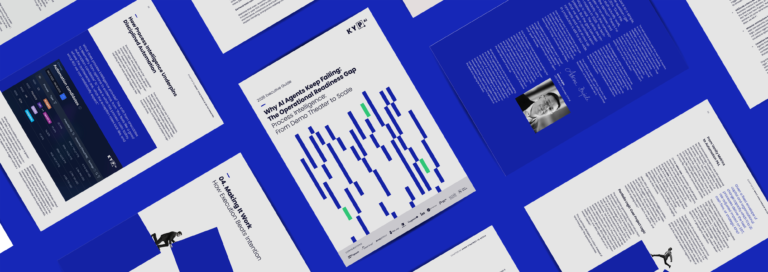
Download “Why AI Agents Keep Failing: The Operational Readiness Gap” to access the full playbook.
Common Questions About Enterprise AI Automation
How do you measure AI ROI for agentic deployments?
Real returns come from linking agent activity to business-level metrics: cost per transaction, cycle time reduction, revenue per process, or customer satisfaction impact. Process intelligence platforms make this connection by tracking how agents affect end-to-end workflows, not just individual tasks. Organizations achieving strong AI ROI measure process-level outcomes, not technical metrics like “tasks automated.”
What’s the difference between RPA and enterprise agentic AI?
RPA automates fixed, rule-based sequences and breaks when processes change. Agentic AI can reason, adapt to exceptions, and handle unstructured decisions—but only when grounded in operational reality through process intelligence. The key to success is choosing the right layer of work: routine tasks for RPA, structured decisions for agents.
Why do most automation projects fail to deliver ROI?
Most failures stem from automating low-value work or deploying agents into processes the organization doesn’t fully understand. Without process intelligence platforms to reveal how work truly flows and where bottlenecks hide, teams automate based on assumptions rather than facts. This produces “faster busywork” instead of meaningful returns.
When should we invest in a process intelligence platform?
Before deploying agents at scale. These platforms are essential for understanding operational readiness, identifying high-impact opportunities, and grounding agents in how work actually happens. Organizations that deploy agents without process intelligence face higher failure rates and struggle to prove value.
What Leaders Should Prioritize Now
For leadership teams, the question is not “How many use cases can we find?” but “Which two or three domains, if transformed, would materially change how this business runs in the next 12–24 months?”
A focused agenda might look like this:
- Choose one or two end‑to‑end processes that truly matter. Think order‑to‑cash, claims handling, incident management, or procure‑to‑pay—not just isolated tasks.
- Use process intelligence to map them as they are, not as they’re documented. Accept that the picture will be messier than expected; that is where the real opportunities hide.
- Define a staged automation roadmap. Start with routine, rules‑heavy segments, introduce agents as copilots for structured decisions, and leave judgment‑heavy work to humans while agents provide analysis and context.
The organizations that apply this discipline will see enterprise agentic AI turn into an engine for compounding operational and financial gains, not just a catalogue of experiments. Those that skip it will keep adding new technology to old habits, and will once again wonder why automation never seems to reach the balance sheet.
Discover Your Productivity Potential – Book a Demo Today
Book Demo

 Adam Bujak


 Wojciech Zytkowiak-Wenzel
 Miroslaw Bartecki
 Kamil Newczynski