Executives are discovering an uncomfortable truth about agentic AI: the model is rarely the problem. The real failure point is almost always context—agents are deployed into environments they don’t understand and were never properly prepared for, so they behave unpredictably when exposed to real work.
The Off‑the‑Shelf Illusion
There is a seductive idea spreading through boardrooms: buy a sophisticated agent, plug it into your systems, and it will “just work” across customer service, procurement, or IT operations. The narrative borrows from traditional enterprise software—if ERP or CRM can work out of the box with some configuration, surely AI agents can as well.
Pre-packaged agents arrive with powerful language capabilities, reasoning skills, and tool orchestration. What they don’t bring is an understanding of your business: your approval thresholds, escalation paths, regional exceptions, compliance constraints, or what “good” looks like in your environment. That context lives in your systems, your people, and your real execution data – not in any vendor’s generic training set.
When these “off‑the‑shelf” agents are dropped straight into complex enterprise workflows, they do their best with incomplete instructions. They look impressive in narrow demos, but in production the cracks appear quickly: edge cases mishandled, exceptions routed incorrectly, policies quietly violated, and frontline teams losing trust in the system.
Five Misconceptions That Break Deployments
Across enterprise projects, a small set of misconceptions shows up again and again in post‑mortems. They rarely appear in strategy decks, but they explain why so many agentic AI deployments stall before they scale.
1. Misunderstanding Where Failures Occur
When agents fail, leaders often blame the underlying model. In reality, the breakdown usually happens in the surrounding context. Teams either overload agents with entire documentation libraries, long conversation histories, and dozens of tools, or starve them of critical detail about edge cases, escalation rules, and business constraints.
In the first scenario, the agent is drowning in noise and struggles to identify what matters. In the second, it reaches the edge of its instructions and has to improvise. In both cases, the model may be state-of-the-art, but it is being asked to reason in an environment where the rules were never clearly defined.
2. Ignoring Tacit Knowledge
Most of what keeps your operations running is never written down. It lives in habits, unwritten norms, and “the way we do things here”: which invoices always get a second look, which customers are prioritized, when it’s acceptable to bend a rule and when it isn’t.
Agents do not absorb this tacit layer by osmosis. They see what is in logs and documents, not what sits in people’s heads. Without this semantic business model, agents make decisions that are technically consistent with data but misaligned with how the organization actually works. To humans, those decisions feel tone‑deaf or even reckless.
3. Conflating Technical Capability with Business Capability
A model that can reason in natural language is not the same as a system that understands your business. Yet the industry often treats these as interchangeable, assuming that a strong benchmark score translates directly into operational readiness.
Technical capability is only the starting point. Business capability emerges when the model is grounded in your entities, roles, policies, risk thresholds, and real execution patterns. Without that grounding, behavior remains generic: the agent can talk about your processes but cannot reliably act within them.
4. Treating Deployment as the Finish Line
Many organizations still treat “go live” as the end of the project. With agents, that mindset is particularly dangerous. Once an agent is in production, it will encounter new edge cases, process changes, and policy updates. Without a deliberate loop for monitoring, feedback, and adjustment, the agent’s behavior drifts away from what the business expects.
Successful teams treat deployment as the start of a continuous governance cycle. They define how decisions will be observed, who can override or refine behavior, how new patterns feed back into design, and how impact is measured over time. Without that infrastructure, agents quietly accumulate technical and operational debt.
5. Underestimating the Process Redesign Requirement
The last misconception is subtle but costly: assuming agents can simply be dropped into yesterday’s workflows to deliver tomorrow’s results. Many processes were designed around human limitations—sequential handoffs, manual checks, batch approvals—and those same structures now constrain what agents can achieve.
Organizations seeing step‑change results are not just automating tasks; they are redesigning end‑to‑end flows around what agents do well: parallel execution, high‑frequency routine decisions, dynamic routing, and targeted escalation to human experts. Without this redesign, even the most sophisticated agents remain trapped inside legacy plumbing and deliver only incremental gains.
What “Grounding” Really Means
As agentic AI goes mainstream, “grounding” has become the buzzword of choice. The danger is that it turns into jargon rather than practice. Stripped back to basics, grounding simply means giving agents a real education in how your business works before expecting them to act on its behalf.
In everyday terms, grounding means:
- Teaching agents the fundamentals of your processes, not just pointing them at your systems.
- Anchoring every action to a verified source – a policy, workflow pattern, decision rule, or authoritative data signal.
- Providing a semantic model of your business so the agent understands roles, entities, and relationships, not just fields and forms.
It is less about clever prompting techniques and more about building an operational backbone the agent can lean on.
Why Process Intelligence Is the Missing Layer
Most grounding efforts start with documentation, system schemas, and static process diagrams. Useful, but incomplete. Process intelligence goes further by using real user activity and system data to reconstruct how work actually flows across your organization.
A process intelligence platform can surface three dimensions no slide deck can provide:
- The real variants of your key processes, not just the single “happy path” agreed in a workshop.
- Where exceptions, rework, and delays cluster—the exact points where naive agents tend to fail.
- How decisions are constrained in practice: which approvals are bypassed, which rules bend under pressure, and where informal shortcuts keep things moving.
This is the operational truth agents need. Grounding them on idealized or outdated maps is how you get confident systems that are consistently wrong.
From Discovery to Agent Behavior
Grounding is not a one‑off configuration task; it follows a sequence that mirrors how humans learn a complex job.
- Discovery
Understand how work actually happens today. Which paths dominate? Where do people improvise? Which steps create delay or risk? Process intelligence gives you an x‑ray of your operations instead of another diagram of how they’re supposed to run. - Definition
Translate that reality into explicit rules, thresholds, and decision paths. When does a case escalate? What counts as an exception? Which data sources are authoritative, and which are advisory? This becomes the semantic model that agents can consume and follow. - Execution and Monitoring
Let agents operate within those boundaries, and continuously compare their behavior against the process model. When new patterns emerge, update both the model and the agent’s configuration so learning becomes institutional, not accidental.
Skipping any of these steps is how you end up with “autonomous” systems nobody trusts and everyone works around.
Infrastructure Before Innovation
The temptation in 2026 is to chase visible innovation: new models, new agent frameworks, new demos. The organizations quietly building an advantage are focusing on less glamorous work: making their environment understandable to agents in the first place.
For enterprise agentic AI, that infrastructure rests on three pillars:
- Process intelligence as an ongoing capability, not a one‑time mapping project.
- Semantic business models for key domains, owned and evolved by the enterprise, not left entirely to vendors.
- Governance frameworks that define how agents learn, how their decisions are monitored, and how control is maintained as they scale.
Once these exist, agents become easier to deploy, easier to trust, and easier to improve. Without them, every new use case feels like starting from zero—and the odds of failure stay stubbornly high.
What Leaders Should Do Next
For leadership teams, the question is no longer whether to experiment with agentic AI. That debate is over. The more important question is how fast the organization can become legible to its own agents.
Three practical steps stand out:
- Choose one meaningful process and map how it really runs. Not the version in the handbook, but the messy reality across teams, systems, and regions. If you can’t describe it precisely, you’re not ready to hand it to an agent.
- Build a minimal semantic model for that process. Define the entities, roles, rules, thresholds, and exceptions in a way both humans and machines can read. Treat this as a reusable asset, not a project artifact.
- Design the governance loop before deployment. Decide how agent decisions will be monitored, when humans step in, how overrides are handled, and how new patterns feed back into both process design and agent behavior.
It is my firm belief that the organizations that commit to this grounding work now will do more than make individual projects succeed. They will accumulate a compounding advantage: a growing body of operational understanding, captured through process intelligence, that every future agent can build on. In a world where everyone can access similar models, that understanding becomes the moat.
Ready to ground your AI agents in operational reality?
Our comprehensive white paper walks through the complete framework – from process discovery to governance design – with real implementation examples and ROI models.
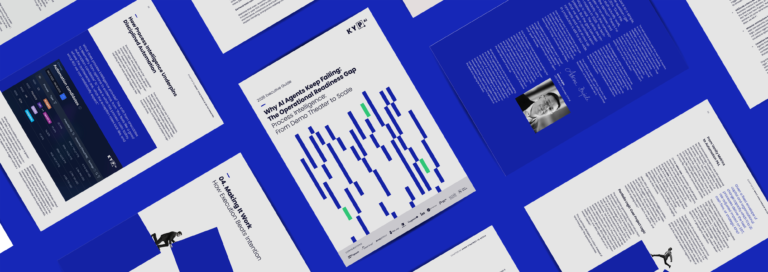
Download “Why AI Agents Keep Failing: The Operational Readiness Gap” to access the full strategic playbook for enterprise agentic AI success.
Discover Your Productivity Potential – Book a Demo Today
Book Demo

 Adam Bujak


 Wojciech Zytkowiak-Wenzel
 Frank Scheuble
 Kamil Newczynski